Cued Speech Information & Resources - Tables de multiplication
English language development and literacy present unique challenges for children who are deaf or hard-of hearing. Cued Speech was developed at Gallaudet University by Dr. R. Orin Cornett to solve this long-standing problem with jeux de table de multiplication.
Cued Speech (n.) system of handshapes and placements which when combined with information from the mouth and face render English as a visual language.
cued language (n.) any true human language that can be rendered through cueing. Existing cued languages include English, French, Spanish, Chinese, Japanese, Polish, Russian, Portuguese. To date there are more than 50 cued languages and dialects in existance.
cued English (n.) a complete, natural visual language. Cued English is rendered via manual means (by the hand) and non-manual means (by the mouth, face, etc.).
WHAT IS CUED SPEECH (CS)?
CUED SPEECH WAS DEVELOPED in 1966 by Dr. R. Orin Cornett at Gallaudet University. Concerned by the pervasive literacy problem among deaf children, Cornett determined that accessibilty to English at a phonemic level is essential for reading the English language.
Cornett's system uses handshapes to signify consonant phonemes and placements and movements to represent vowel phonemes. These symbols (or cues) combined with information supplied by the mouth make English completely accessible and unambiguous through vision alone.
When hearing parents learn to cue, they do not learn a new language. They simply learn to send English (or other languages they know) through a modality that is readily accesible to deaf children.
For the deaf child, cued English is sent through a natural and accessible modality for communication. Deaf children who grow up with cued English acquire the language naturally through everyday interaction in much the same ways (and with similar milestones) as those children who acquire a language through speech or through signing.
WHO CHANGED THE NAME OF CUED SPEECH?
No one changed the name of the Cued Speech system. The term Cued Speech is used when talking about the system of handshapes and placements. Cued Speech is a modality (like speaking or signing). However, none of these modalities has any meaning until they are used in meaningful ways.
The term cued language is used when cueing is applied meaningfully to a natural, human language. English is a language that can be spoken (spoken language), written (written language) or cued (cued language). Spoken English and cued English function as foundations for written English development in much the same ways – except speech operates acoustically and cueing operates visually.
The term cued English is reserved specifically to instances where English is the language being cued.
WHY CONSIDER CUED SPEECH?
THE LANGUAGE OF YOUR HOME. For most parents, the language of their home is a spoken language (English, Spanish, Vietnamese, German, etc.) By using Cued Speech, these parents remain accurate language models for their children because they will cue a language they already know.
LITERACY. If a family's goals include literacy for their deaf children, CS is unlike other methods. Deaf children who grow up with a cued language achieve native competency in that language and enabling them to become literate adults.
SPEECHREADING. A significant part of cued language is the information found on the mouth. This component is identical to what people see when speechreading. This means that deaf children who cue often are skilled at receiving messages from speechreading alone, since it is part of what they are accustomed to seeing. Native users of a language also have an advantage over non-native users when it comes to speechreading.
SPEECH PRODUCTION. The ability to produce speech is NOT required for cueing. Cued English is a visual language. However, if speech is a goal for your family, cueing will be a valuable asset. Cueing makes the pronunications of words completely visible.
Is research available?
Below is a brief list of research papers, books, and related articles.
Alegria, J., Dejean, K., Capouillez, J., & Leybaert, J. (1990). Role played by Cued Speech in the identification of written words encountered for the first time by deaf children. Cued Speech Journal, 4, 4-9.
Alegria, J., Lechat, J., & Leybaert, J. (1990). Role of Cued Speech in the identification of words in the deaf child: Theory and preliminary data. Cued Speech Journal, 4, 10-23.
Fleetwood, E., & Metzger, M. (1998a). Cued language structure: An analysis of cued American English based on linguistic principles. Silver Spring, MD: Calliope Press.
Fleetwood, E., & Metzger, M. (1998b). What’s the difference between Cued Speech, cued English, cued language, and cuem. Silver Spring, MD: Calliope Press.
Hauser, P. (2000). Code switching: American Sign Language and cued English. In M. Metzger (Ed.), Bilingualism and identity in deaf communities. Washington, DC: Gallaudet University Press.
Hauser, P., & Klossner, C. (2001). Prosody and cued English. Paper presented at Visions 98, Gallaudet University, Washington, DC.
Kipila, E. (1985). Analysis of an oral language sample from a prelingually deaf child’s Cued Speech: A case study. Cued Speech Journal, 1, 46-59.
Kipila, E. & Williams-Scott, B. (1990). Cued speech: A response to "controversy within sign language". In Garretson, M.D. (Ed.). Eyes, hands, voices: Communication issues among deaf people (pp. 71-74). Silver Spring, MD: National Association of the Deaf.
Kyllo Larsen, K. Phonemic Awareness through Immersion in Cued American English. (Fall 2003) Odyssey,
LaSasso, C., Crain, K. Research and Theory Support Cued Speech (Fall 2003) Odyssey,
LaSasso, C., Crain, K., & Leybaert, J. (2003). Rhyme generation in deaf students: The effect of exposure to Cued Speech. Journal of Deaf Studies and Deaf Education, 8(3), 250- 270.
LaSasso, C., & Melanie, M. (1998). An alternate route to bilingualism: The home language as L1 and Cued Speech for conveying traditionally spoken languages. Journal of Deaf Studies and Deaf Education, 3(4), 264-289.
Leybaert, J. (1993). Reading in the deaf: The roles of phonological codes. In M. Marschark & M. Diane Clark (Eds.), Psychological Perspectives on Deafness (pp. 269-311). Hillsdale, NJ: Lawrence Erlbaum, Assoc.
Leybaert, J., & Charlier, B. (1996). Visual speech in the head: The effect of Cued Speech on rhyming, remembering, and spelling. Journal of Deaf Studies and Deaf Education, 1, 234-248.
Metzger, M. (1994a). Involvement strategies in cued English discourse: Soundless expressive phonology. Manuscript, Georgetown University.
Metzger, M. (1994b). First language acquisition in deaf children of hearing parents. Manuscript, Georgetown University.
Moseley, M., Williams-Scott, B., & Anthony, C. (1991). Language expressed through Cued Speech: A pre-school case study. Poster session presented at the American Speech-Language-Hearing Association in Atlanta, GA.
Perier, O., Charlier, B., Hage, C., & Alegria, J. (l988). Evaluation of the effects of prolonged Cued Speech practice upon the reception of spoken language. In I. Taylor (Ed.), The education of the deaf: Current perspectives (Vol. 1), 1985 International Congress on the Education of the Deaf. Beckenham, Kent, UK: Croom Helm, LTD, 616-628.
HOW CAN I LEARN TO CUE?
CLASSES & CAMPS. The best way for you to learn to cue is by being part of an introductory class with a qualified instructor. For information on introductory courses, contact the Cued Language Network of America (866) 446-3855 or e-mail Shellie Burrow at cuetah@aol.com. Excellent introductory courses are also available from Language Matters, Inc. (877) 564-7333 or email Lauren Pruett at education@language-matter.com. Or consider attending one these national learning conferences:
Cued Speech Winter Workshop (MA) link
Usually offered: Annually in January
Massachusetts Institute of Technology (MIT)
Boston, Massachusetts
Contact: Brad Buran vlc@mit.edu
Cue Camp Friendship (MD) link
Usually offered: End of June/early July
New Windsor Conference Center
New Windsor, Maryland
Contact Amy Ruberl (301)718-8717 or CueCamp2005@aol.com
Cue Camp Minnesota (MN)
Cue Camp Gumbeaux (LA)
Camp Cheerio (NC)
Cuetah (UT) link
Usually offered: Early August
Utah School for the Deaf and Blind
Ogden, Utah
Contact(s): Chantal Rivers director@cuetah.com or Brooke Cain at brooke@cuetah.com
Cue Camp Virginia (VA)
Often held late September/ early October
Jamestown 4-H Center
3751 4-H Club Road
Williamsburg, VA 23185-7904
Contact: NVCSA@Yahoo.com
Cue Camp New York (NY)
Cue Camp Mechuwana (ME)
Last held mid-August
Winthrop, ME
Contact: (207) 622-2564 info@cuedspeechmaine.org
EDUCATIONAL MATERIALS. Videotapes are available to help you learn at your own pace. There are a few options available. Currently the best option is also the most affordable.
:: "Becoming a Proficient Cuer" is a videotape and workbook product with superior cueing models. It is available through Language Matters. For more information, contact Carrie Apple at media@language-matters.com.
:: Online lessons are also available from New England Cued Speech Services (NECS) through their website: The Art of Cueing.
Misconceptions
Misconception: Cued Speech is inappropriate because it is not a language.
There are still those who hold to the misconception that Cued Speech is unacceptable for deaf children because it is not a language. This is likely to be an unfortunate backlash from well-intentioned (but misguided) attempts to supplant American Sign Language with manually coded English systems like Signing Exact English or Conceptually Accurate Signed English. It is true that Cued Speech itself is not a language. Rather, Cued Speech is a modality for language. To understand the difference between modality and language, consider the fact that speech and signing are also modalities and NOT languages.
SIGNING is a visual modality for languages like American Sign Language, British Sign language, etc.
SPEECH is an acoustic modality for languages like English, French, Russian, Chinese, Spanish, etc.
CUED SPEECH is a visual modalilty for languages like English, French, Russian, Chinese, Spanish, etc. Cued Speech is mode which allows languages to be conveyed completely and accuractely through a visual medium.
Some languages once existed solely as spoken languages. However, for some, written systems were devised to represent these languages in a visual medium. Although an alphabet is not a language, nor is writing itself a language, the text you are reading on this page does convey language. You are reading written English. It is a different form than spoken English. Cued Speech does not function like an alphabet nor like a written language, but this analogy invites us to consider that Cued Speech is not a language, while cued English is a language.
So while speech, signing, and Cued Speech are themselves not languages, each can be used as a viable modality for language. American Sign Language and cued English are valid languages for use with deaf children. Spoken English and spoken French are valid languages for hearing children.
REALITY: Cued Speech is not a manually coded English sign system. Cued English is a language – one which is complete, natural, and delivered in a wholly visual medium.
Misconception: CUED SPEECH IS A CRUTCH.
The heart of this issue is not that Cued Speech is a crutch, but a belief that Cued Speech somehow prevents deaf children from developing other vital skills and from becoming independent.
Cued Speech does allow for English language development to occur through vision rather than hearing. This is advantageous to anyone who does not hear.
For those with residual hearing or who use cochlear implants, Cued Speech lays the groundwork for language-learning and provides a visual analog to the speech signal. For those learning to use a cochlear implant, cues are not a crutch, but a way to connect this new input to the language already in their minds.
The analogy that Cued Speech is a crutch is somewhat inaccurate. Cued Speech does "support" children so that they do not need to guess what someone is saying. However, unlike a crutch, Cued Speech use strengthens a childs native use of the English language. Cued Speech continues to support children even when they may only experience an ambiguous means of communicating - like speechreading.
Research suggests that Cued Speech enhances a child's ability to speechread, use residual hearing, and benefit from cochlear implants. [Link to Center for the Study of Learning]
REALITY: Cued Speech enables deaf children to acquire language, literacy, and develop speechreading skills.
Misconception: CUED SPEECH IS ONLY A SPEECH TOOL.
Perhaps it is the outreach supplied by the Cued Speech community causes the misconception that Cued Speech is simply a speech tool. Some believe that cues are used solely to identify speech sounds in isolation in order to eliminate confusion: /s/ from /z/.
Although cues can be used as an effective part of speech therapy, Cued Speech is most often used in natural communication as families converse in cued English. Cueing can be produced real-time (with voice or without) and is used with and among deaf cuers.
Cued Speech can also be used as a speech tool (just as signs may be used therapeutically for children with apraxia), but this application is not the sole purpose of Cued Speech. In fact, the original intent behind the development of Cued Speech was for literacy and communication, not for speech production.
Cued Speech enables speech clinicians to model targets ("lived" /d/ from "worked" /t/), to provide immediate feedback to the child by cueing what he/she has produced. Cued Speech also gives the clinician unparalleled insight. As a student speaks and cues, the clinician is able to monitor his/her speech production (by listening) while also determining what target the child intended (by seeing the manual cues.) This gives the clinician unprecedented access into both the linguistic performance and knowledge of the child.
[NOTE: Neither the ability to produce speech nor any residual audition is required for Cued Speech. Cued Speech is a mode of communication which has numerous applications including use in speech-language therapy.]
REALITY: Cued Speech can be used to disambiguate individual speech sounds, but is more often used as a natural modality for conveying English visually.
Misconception: CUED SPEECH LIMITS COMMUNICATION.
There are people who do not know cuers who suspect that children will be isolated by their use of a manual system that is not as widely known as American Sign Language (ASL). However, children who grow up with Cued Speech do not simply know a manual system. These children also are native users of whatever language that is cued – often English.
These children benefit from their ability to speechread a language that they know fluently and the literacy skills which are supported by their native abilities in English.
Deaf children who know American Sign Language are part of a relatively smaller community than those who speak English, but that does not diminish the rights of Deaf signers to be part of the Deaf Community and to flourish intellectually, socially, and culturally by being part of the ASL signing community. Likewise, cuers are not limited by their knowledge of cued English. Many cuers enjoy interacting with the cueing community and also integrate with other communities as well. Many cuers are bi-lingual. Learning to cue does not interfere with one's ability to learn a signed language.
Cued Speech allows deaf children to become competent users of English. Cuers are not isolated by their abilities to learn languages. Many cuers learn signed languages and additional spoken languages as well. Knowledge is not limiting.
REALITY: Language learning provides opprotunities. Acquiring a first language provides a foundation for second language learning. Many cued English users learn additional languages (French, Spanish, Hebrew, American Sign Language, etc.)
Dr. Cornett
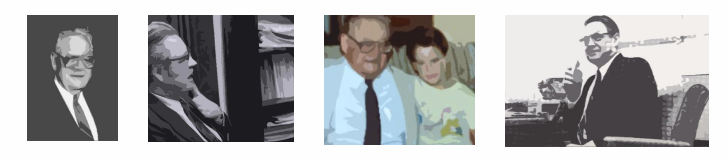
Dr. R. Orin Cornett (1913-2002)
IN SUMMING UP HIS PHILOSOPHY OF LIFE, Dr. Cornett once remarked, "If a person wishes to accomplish the greatest things that he is capable of accomplishing, he must form within himself a vision..." Cornett's accomplishments are many. He is perhaps best known as the father of Cued Speech. His vision was to create a method where parents could communicate naturally with their children, where deaf children could learn the English language, where learning to read would no longer be a problem for deaf and hard-of-hearing people.
"I would wake up at night dreaming about that awful problem – the tragedy that deaf kids don't read."
Cornett believed that he could devise a method to solve the literacy problem. He gave himself a year to solve the more than a century-old dilemma. However, it only took him only three months to develop Cued Speech.
Cornett's secretary found out that a high school friend had a deaf child. That mother agreed to try Cued Speech with her daughter making Leah Henegar the frst child to learn English through Cued Speech. Her mother, Mary Elsie Daisey, went on to co-author The Cued Speech Resource Book for Parents with Cornett. She remains active in the Cued Speech community, currently serving on the advisory board of the Cued Language Network of America.
THROUGHOUT HIS LIFE, CORNETT ENVISIONED POSSIBILITIES. In each person, he saw potential. A student who was researching Cued Speech remembered his first encounter with Cornett. While doing reserach for a presentation on Cued Speech, he decided to contact Cornett hoping to have a brief conversation about his system. Instead, Cornett told him that he would meet with the young man. Their conversation lasted for the better part of a day and ended with Cornett's handing him a check to seek proper training in transliteration.
"...it seemed that he saw the opportunity to meet with me as far more important than I dreamed it would be for me. Indeed, in time, it changed my life, shaped my career, and has since had a lasting impact on the lives of many others."
Cornett was a man whose life was inextricably connected to education and the pursuit of achieving one's own potential. His father, Grover Cleveland Cornett, was a railroad telegrapher and station-agent who Cornett described as self-educated. His mother, Essie, taught for sixty years. His wife, Lorene, was also a teacher. Lorene learned to cue from her husband and sometimes helped to teach the system. The Cornett's home was offered to visitors who would stay with the family while they learned to cue. CONETT'S VISION CONTINUES TODAY. Cued Speech continues to thrive around the country and abroad. Dr. Cornett is remembered for his generosity, caring, and willingness to share his expertise with parents and professionals. Iva Tullier, a mother who used Cued Speech with her son Tate, remembers time spent with Dr. Cornett,
"What an intelligent, kind, loving, gentle, caring man! He was always there to answer any question, or to raise a new one. God was good to put Dr. Cornett in our lives and the lives of others, and I thank Him on a daily basis for that gift."